


The time for qurban slaughter begins on the first day of Eid al-Adha (the 10th day of Dhu al-Hijjah): in places where the Eid prayer is performed, it begins with the conclusion of the prayer, and in villages and similar places where no Eid prayer is held, it begins with true dawn (fajr al-sadiq, the time of imsak). The qurban is one of the fundamental acts of worship in Islam, and its ending times differ according to the schools of law. This guide examines the time for qurban slaughter, its religious foundations, who is obligated to perform it, and the method of slaughter in full detail.
When Does the Time for Qurban Slaughter Begin?
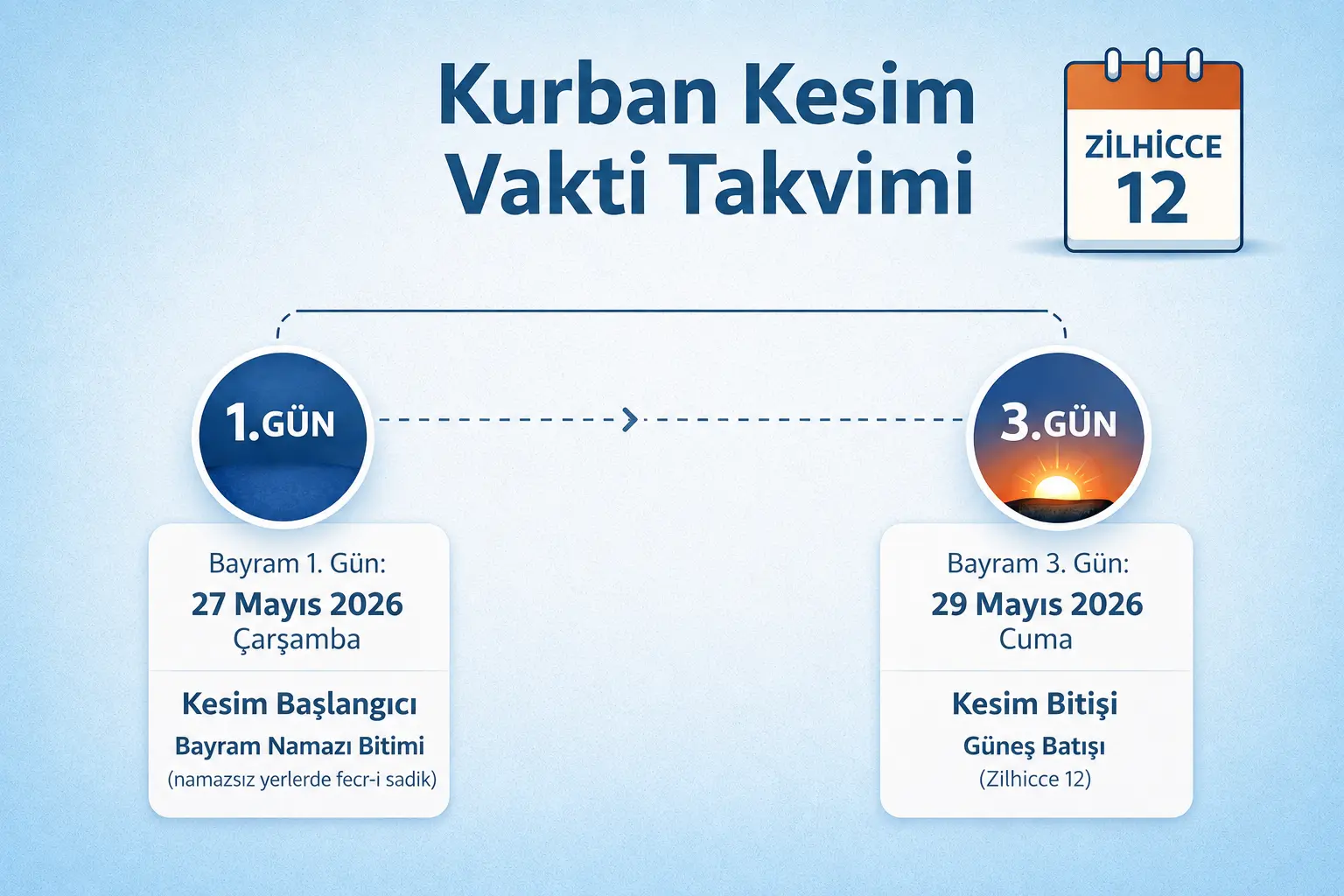
The time for qurban slaughter begins on the first day of Eid al-Adha, which is the 10th day of the month of Dhu al-Hijjah. In cities and towns where the Eid prayer is performed, the slaughter becomes permissible with the conclusion of the Eid prayer. In villages and similar places where the Eid prayer is not held, the slaughter may begin from true dawn (fajr al-sadiq) (the time of imsak).
The first day also holds a special significance: according to the great majority of Islamic scholars, it is more meritorious to perform the qurban on the first day of Eid. Moreover, when one is in a position to perform the Eid prayer, beginning the slaughter early is also more in keeping with the spirit of the prayer.
When Does the Time for Qurban Slaughter End According to the Schools of Law?
Regarding the time for qurban slaughter, the schools of law differ as to the ending day. This difference is shaped by the number of the days of Tashriq:
| School | Start of Slaughter | End of Slaughter |
|---|---|---|
| Hanafi | 1st day, conclusion of the Eid prayer (true dawn in places without a prayer) | 3rd day (12 Dhu al-Hijjah) at sunset |
| Shafi’i | 1st day, conclusion of the Eid prayer | 4th day (13 Dhu al-Hijjah) at sunset |
| Maliki | 1st day, conclusion of the Eid prayer | 3rd day (12 Dhu al-Hijjah) at sunset |
According to the Hanafi school, which is widely adopted in Turkey, the period for qurban slaughter is three days: the 10th, 11th, and 12th days of Dhu al-Hijjah. An animal slaughtered outside these three days does not count as a qurban.
The Definition and Ruling of the Qurban as an Act of Worship
The word qurban means, in the dictionary, “to draw near” and “that which serves as a means of attaining nearness to Allah.” As a juristic concept, the qurban means slaughtering, in accordance with the prescribed method and with the intention of worship, certain animals that possess particular qualities — sheep, goat, cattle, water buffalo, or camel — on the specified days of the month of Dhu al-Hijjah.
According to the Hanafi school, performing the qurban is wajib for every Muslim who, apart from their essential needs and debts, possesses wealth to the amount of the nisab (80.14 grams of gold or its equivalent in value). The Hanbali school evaluates it to a similar degree, while according to the Shafi’i and Maliki schools it is regarded as a confirmed sunnah (sunnah mu’akkadah).
The Religious Foundations of the Qurban: Verses and Hadith
The qurban is an ancient act of worship grounded in the Noble Qur’an and authentic hadith. The principal sources are as follows:
Evidence from the Noble Qur’an
فَصَلِّ لِرَبِّكَ وَانْحَرْ
Transliteration: Fe-salli li-rabbike venhar
Meaning: “So pray to your Lord and sacrifice.” (Surah al-Kawthar, 108/2)
Evidence from the Noble Hadith
مَنْ وَجَدَ سَعَةً وَلَمْ يُضَحِّ فَلَا يَقْرَبَنَّ مُصَلَّانَا
Meaning: “Whoever has the means to perform a qurban but does not do so, let him not draw near to our place of prayer.” (Ibn Majah, Adahi, 2)
“Perform the qurban; indeed, the practice of the qurban is the sunnah of your father Ibrahim.” (Ahmad ibn Hanbal, Musnad)
Who Is Obligated to Perform the Qurban?
According to the Hanafi school, four basic conditions are required for the qurban to become wajib upon a person:
- Being a Muslim: The qurban is an act of worship that is wajib only upon Muslims.
- Being free, of sound mind, and having reached puberty: According to the view of Imam al-A’zam (Abu Hanifa), a qurban may also be performed on behalf of a wealthy child from the child’s own wealth by their guardian.
- Being a resident: The qurban is not wajib upon those considered travelers (musafir); nevertheless, it is permissible for them to perform it.
- Possessing wealth to the amount of the nisab: A person who, after deducting essential needs and debts, possesses 80.14 grams of gold or its equivalent in value is regarded as “wealthy,” and the qurban becomes wajib upon them.
The Method of Qurban Slaughter: Step by Step
The qurban slaughter is an act of worship that must be carried out without causing the animal distress and in accordance with religious standards. Islamic scholars have specified that the slaughter be performed in the following stages:
- Intention: One intends in the heart to perform the qurban for the sake of Allah’s pleasure. The intention must be made before the slaughter.
- Turning the animal toward the qibla: If possible, the animal is laid on its left side facing the direction of the qibla.
- Basmala and takbir: Immediately before the slaughter, one says “Bismillahi Allahu akbar.” The basmala is an essential condition for the validity of the slaughter.
- The essentials of the slaughter: Cutting the windpipe, the gullet, and the two jugular veins is sunnah. Cutting at least three of these four channels is sufficient for the animal to be considered lawful (halal).
- The prayer of thanksgiving: Performing a two-rak’ah prayer of thanksgiving after the slaughter is recommended (mustahabb) but not obligatory.
May the Qurban Be Slaughtered at Night?
Slaughter may be carried out during the nights that fall within the time for qurban slaughter; this is permissible. However, the scholars of fiqh have characterized performing the slaughter on the first and second nights of Eid as makruh tanzihi (not sinful, yet inadvisable). The principal reason for this is that the likelihood of error increases in slaughters carried out at night, and the required care may not be fully exercised.
For this reason, where possible, it is considered more appropriate for the qurban slaughter to be carried out during the daytime hours.
The Wisdom and Social Significance of the Qurban
The qurban is not merely the slaughter of an animal. This act of worship, which symbolizes the Prophet Ibrahim’s (peace be upon him) submission to Allah, carries a profound spiritual and social meaning:
- A symbol of submission: Every qurban is a concrete expression of the individual’s will to subject their self and their wealth to the command of Allah.
- Social solidarity: Dividing the meat into three parts — 1/3 for the poor, 1/3 for friends and relatives, 1/3 for the members of the household — strengthens the awareness of sharing and mutual aid.
- Gratitude: The servant’s spending of the blessings they possess for the sake of Allah’s pleasure, knowing them to be from Allah, is one of the most visible forms of gratitude.
In cases where more than one person wishes to perform the qurban together, the rulings of partnership (shared sacrifice) come into play.
Frequently Asked Questions
How many days is the time for qurban slaughter?
According to the Hanafi school, the time for qurban slaughter is 3 days: the 10th, 11th, and 12th days of Dhu al-Hijjah. According to the Shafi’i school, this period extends up to 4 days and also includes the 13th day.
May the qurban be slaughtered on the Day of Arafah?
No, the time for qurban slaughter begins with the conclusion of the Eid prayer on the first day of Eid. An animal slaughtered on the Day of Arafah, which is the 9th day of Dhu al-Hijjah, does not count as a qurban; it is regarded merely as an ordinary slaughter for meat.
May the qurban be slaughtered at night?
It is permissible to carry out the slaughter during the nights that fall within the slaughter time. However, the scholars of fiqh have characterized night slaughter as makruh tanzihi because of the likelihood of error. If possible, it is preferable for the slaughter to be performed during the daytime.
What should a wealthy person who could not perform the qurban do?
A wealthy Muslim who was unable to perform the slaughter even though the time for qurban slaughter has passed should give the market value of the qurban on that day to the poor as sadaqah. This constitutes a Shar’i concession with regard to fulfilling the wajib.
Is it permissible to give qurban meat to non-Muslims?
Everyone may benefit from the meat of a non-obligatory (voluntary) qurban without distinction between Muslim and non-Muslim. In the case of vowed (nadhr) or wajib qurbans, however, giving priority to needy Muslims is considered more appropriate from a juristic standpoint.